Return of the Endeavor
Chasing SunlightReturn of the Endeavor is the homecoming event that converts a disastrous far-eastern expedition into a public windfall and a private disturbance. The Endeavor reaches Beacon battered and tattered, carrying immense wealth in gold, but its return also leaves behind a vanished inquisitor, missing underworld rulers, unexplained deaths, and a city whose ordinary gossip cannot quite contain what has happened. The event therefore functions as both a material success and an obscured supernatural rupture: civilization receives the expedition’s wealth while failing, or choosing not, to recognize the violence embedded in its arrival.
Return to Beacon
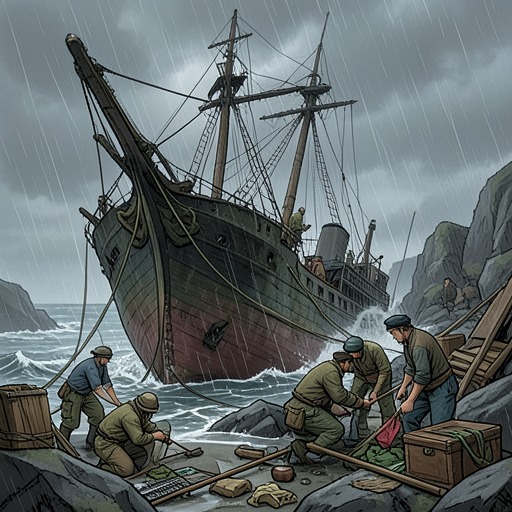
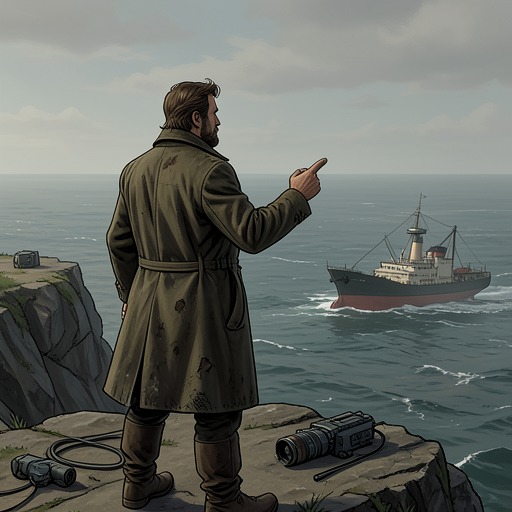
The immediate setting is Beacon and the lands of the Illuminated King at the turning of the season. The population has just witnessed an apparition, but the east has already trained them to absorb extraordinary events without sustained alarm. Immense Glacilium have previously brought unseasonable cold before departing, so even an apparition can be nearly forgotten when the Endeavor finally limps into port. The ship’s damaged condition identifies the return as costly rather than triumphant; it survives, but only in a state requiring substantial repair.
The returning party attracts less attention than the cargo. A lone Inquisition member and an odd trio of women disembark as socially unremarkable passengers, while the quantity of raw gold moving through customs makes many of the airmen minor celebrities. The contrast is decisive: the expedition’s human and political consequences remain obscure, whereas its extractable wealth is immediately legible to officials, opportunists, and the public. The return thus restores the expedition to the economic circuits of Beacon before it restores it to any official account of what occurred in the east.
Wealth, Labor, and Material Aftermath
The gold’s public impact depends on a long chain of preparation and labor. Before departure, Jonathan Heights arranged for supplies to be shipped by train to Danby’s Point, more than a hundred miles from Beacon, so that the Endeavor could travel there quickly without being fully loaded. At the eastern terminus, the expedition assembled a portable luminiferous terrestrite distillation apparatus, a lifting-gas separator, water siphons and filters, portable searchlights, crew-served zint guns, food, water, spare parts, clothing, bedding, and other necessities. The homecoming wealth therefore emerges from an expedition organized as a logistical enterprise, not from a single miraculous discovery detached from transport, equipment, and human effort.
The same expedition repeatedly treats value as something gathered, exchanged, carried, and converted. Jonathan advises the crew that raw metal stock is the best barter in the Verdant Expanse, bringing rolled steel rods himself. He later orders a golden apparatus trimmed and divided among the men, agreeing to carry the main trunk if necessary because the find will improve the crew’s attitude. Eleanor McAvey attacks the mass with a metal chisel, while other airmen use crowbars, pliers, and engineers’ hammers; the golden structure is dissected into portable pieces, with flashes of silver appearing among the fragments. By the time the Endeavor returns, the gold is no longer merely an eastern marvel. It has become wages, customs traffic, repair capital, retirement money, and a source of predatory interest.
The ship itself is repaired with the proceeds. Captain Montgomery spends a breathtaking sum, though only a fraction of the total, on the Endeavor’s restoration. Workers find the ship’s spine and envelope strangely familiar to the touch, while the ship’s cats watch them with uncanny intelligence, but these signs are dismissed as part of the oddness associated with explorers and voyages into the dark. The repair process consequently places the inexplicable inside an ordinary industrial frame: laborers handle the damaged vessel, money pays for reconstruction, and official knowledge neutralizes what it cannot comfortably explain.
Disappearance and Bloodshed
The most conspicuous political consequence concerns the young inquisitor who returns with the expedition. He disappears into Beacon’s tower, and thereafter those who regularly see the Illuminated King remark that the ruler’s light appears brighter and his strength greater. Public speculation divides between the possibility that the inquisitor has been imprisoned or hospitalized somewhere deep within the tower and the darker suggestion that the Illuminated King has consumed him to strengthen his own monstrous life. The latter rumor is suppressed as slander by the Inquisition, but the absence itself remains undeniable.
The return also coincides with a quieter assault on the Reflected Council, the shadowy figures who rule Beacon’s underworld. Certain Council members vanish in the weeks and months after the Endeavor’s arrival. The only remains discovered are copious quantities of blood and a small discarded husk resembling an exotic fruit. No culprit is established, despite investigations by driven and bloodthirsty professionals. Those investigators themselves frequently disappear, leaving the criminal world temporarily less violent because some of its most feared enforcers have been removed.
The pattern creates a double concealment. The disappearance of the inquisitor is absorbed into rumors about the tower and the Illuminated King, while the destruction of the Reflected Council is treated as an unsolved criminal matter. Neither consequence is publicly connected to the Endeavor in a definitive manner. Yet their timing makes the homecoming a threshold between the expedition’s eastern encounters and a new, unacknowledged violence inside Beacon itself.
The Winter of Blood
The combined incidents lead some observers to name the period after the Endeavor’s return the Winter of Blood. Others call it the Winter of the Shadow, a label greeted with some mockery. Both names register the same contradiction: Beacon experiences more excitement than usual, but not enough visible disruption to justify an official crisis. The city’s political order, criminal networks, customs offices, and public routines continue, allowing extraordinary deaths to become rumor rather than history.
The winter’s violence is also distributed unevenly. The underworld loses influential enforcers; investigators vanish; wealthy airmen become targets for thieves and brigands; and the victorious crew acquires the means to resist those attacks. Nearly every airman of the Endeavor becomes rich, and many retire from the profession with greater or lesser success. A brawny airman and a wiry one jointly use their proceeds to purchase an airship, turning the expedition’s gains into renewed access to exploration and transport rather than simple consumption.
Predation follows wealth, but it does not reliably succeed. Veteran airmen prove difficult targets, and several would-be thieves disappear, leaving behind only occasional scorched shadows. These retaliatory absences are scarcely mourned and rarely become public knowledge. The Winter of Blood therefore describes not one announced massacre but an accumulation of violent corrections beneath the surface of prosperity: wealth creates targets, the targets resist, and the city registers the results as gossip.
Significance and Continuation
Return of the Endeavor reverses the expected meaning of an expedition’s homecoming. The crew does bring back an elixir of sorts—gold enough to repair the ship, enrich the airmen, and alter the fortunes of Beacon—but the knowledge and power associated with the east do not return in a form the city can safely integrate. The apparition is forgotten, Antomine’s fate is obscured, the Reflected Council is quietly reduced, and the material treasure becomes the dominant public story.
The event also exposes the limits of Beacon’s categories of civilization. At Danby’s Point, human construction meets the architecture and peoples of the dark beneath the pressure of trade, with the Inquisition simultaneously strongest and weakest at the boundary. The expedition carries that unstable frontier home: its cargo enters customs, its ship enters repair, and its violence enters rumor. The city’s apparent continuity is maintained by treating each disturbance as isolated, even though the timing of the disturbances binds them to the return.
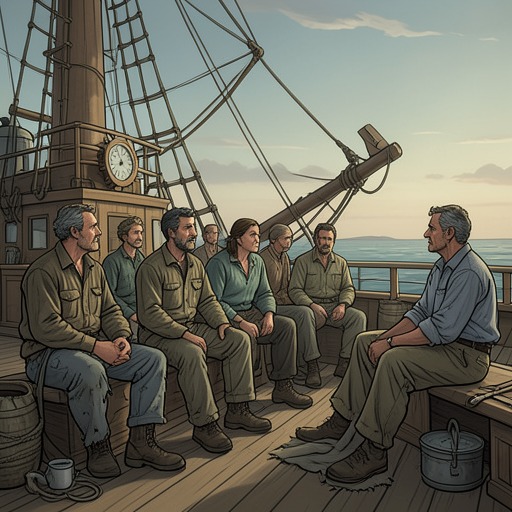
The aftermath does not end the expeditionary cycle. By the time news spreads that Captain Montgomery is outfitting the Endeavor again, the next voyage attracts no more attention than any other minor undertaking. Eleanor remarks that this is a less auspicious departure, while Montgomery replies that, considering what happened last time, he is content with that. Sarah and Marie stand behind Eleanor with Dreyfus and Penelope draped over their shoulders; they no longer present themselves as maids, yet remain within Eleanor’s orbit. Most of the bridge crew are new but experienced, and Montgomery’s reason for going out again is left uncertain, perhaps mere insatiable wanderlust. The Endeavor’s return thus becomes not a conclusion but a temporary concealment, after which the machinery of departure begins again.